- About
- Training
- eLearning
- COR & Auditing
- Resources
- OHS Legislation
- News & Events
- Job Postings
- Cognitive Psychosocial JDA
- Forums
- Lawn Maintenance Safety Toolkit
- Work Site Parties
- Contractor Management
- Videos
- Newsletters
- Onboarding Seasonal Workers
- SafetyNet Library
- WCB Updates
- Industry Task Force
- Supporting Seasonal Workers
- OEL Technical Working Group
- WCB-Alberta Premium Rates
- Part 40: Utility Workers - Electrical Technical Working Group
- Support
August 2026
.png)
Issue #2 - Building better audits
Quality audits are built on thoughtful planning, clear documentation, and continuous learning.
As the 2026 audit season continues, AMHSA is pleased to share practical updates and resources to help auditors strengthen consistency, improve report quality, and stay informed of evolving auditing practices. In this edition, you’ll find:
- Guidance on audit sampling
- Tips for writing effective auditor justification notes
- Employer / company profile requirements and;
- Reminders about the growing collection of webinar recordings and resources available to support your success
Considering Unmanned and Seasonal Sites During Audit Planning
Effective audit sampling begins with developing a complete understanding of an employer’s operations. As part of ongoing discussions with municipalities and our government partners, AMHSA has been exploring how unmanned and seasonal sites fit within the overall sampling process. These conversations are intended to support consistent, risk-based audit planning while maintaining the management systems approach of the COR audit.
Many municipalities operate sites that may not be regularly occupied, such as volunteer fire halls, water or wastewater facilities, transfer stations, campgrounds, parks, outdoor pools, or other seasonal locations. Although workers may only attend these sites periodically, they remain part of the employer’s operations and should be considered during audit planning.
What to consider during sampling plan development
When developing the sampling plan to submit to AMHSA, auditors should be:
- Identifying and listing unmanned and seasonal sites as part of understanding the employer’s overall operational footprint. View the Audit Sampling Procedure, Appendix C for more information on how to list.
- Consider whether workers perform activities at these locations that involve unique or higher-risk hazards.
- Evaluate whether an observation tour of the site would provide meaningful evidence beyond what can be obtained through interviews, documentation, hazard assessments, or safe work procedures.
- Use professional judgement to select observation tour locations that best represent the employer’s operations and provide the greatest value during the audit.
Not every unmanned or seasonal site will need to be visited during an audit. In many cases, the hazards associated with work at these locations can be effectively evaluated through documentation review, worker interviews, and an assessment of the employer’s hazard identification and control processes.
Building awareness in 2026
For the 2026 audit cycle, auditors are encouraged to identify unmanned and seasonal sites during sampling plan development to help ensure the plan reflects the employer’s complete operational footprint. This is intended as an awareness initiative that promotes thoughtful consideration of all operational areas while allowing auditors to apply professional judgement when selecting observation tour locations.
Resources available
To support sampling plan development, auditors can review:
- Audit Registration and Sampling Approval Procedure
- Audit Sampling Procedure
- [Webinar Recording] Audit Sampling: Simple & Complex Samping Strategies
These resources provide additional guidance for developing representative, risk-based sampling plans that accurately reflect an employer’s operations.
looking ahead to 2027
Beginning in 2027, the expectation is that auditors will identify unmanned site categories on the sampling plan and, where applicable, visit one representative unmanned site from one category during the audit. Site categories would rotate over successive audit cycles rather than requiring a visit to every category in each audit.
writing quality auditor justification notes
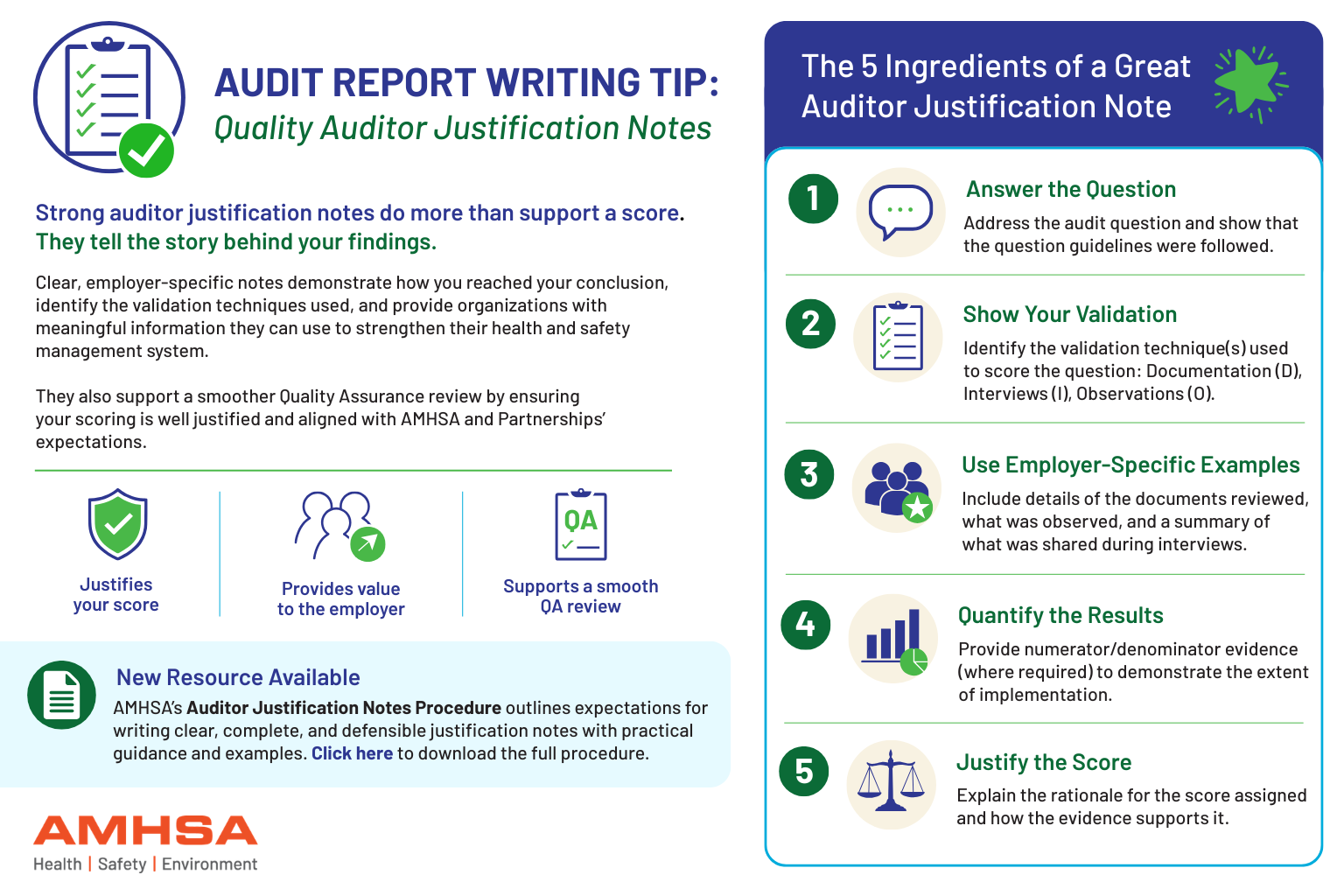
Strong auditor justification notes do more than support a score—they tell the story behind your findings. Quality Assurance Reviews consistently require revisions to justification notes to meet standards. AMHSA has developed resources to assist auditors in what the requirements are for justification notes.
Clear, employer-specific justification notes demonstrate how you reached your conclusions, identify the validation techniques used, and provide organizations with meaningful information they can use to strengthen their health and safety management system. Download this visual keep handy when writing your reports. For more information, review the Auditor Justification Notes Procedure.
company profile requirements in audits
Recent feedback from a Partnerships Program review identified that Company Profile’s provided in audits are missing key requirements. The company profile is more than an introduction to the organization being audited—it provides important context for the entire audit. A well-written profile helps reviewers understand the employer’s operations, demonstrates the auditor’s understanding of the organization, and provides the foundation for evaluating whether the sampling plan appropriately represents the employer’s activities.
What should an employer/company profile include?
The standard requires auditors to provide a brief description of the employer’s operations as they relate to the audit. In the Excel Audit Tool, this is to be entered in the Exec Summary section in the Introduction field. In the AuditSoft Tool, under the Summary Information section, there is a section called Employer / Company Profile.
The profile should clearly describe:
- The type of work performed by the employer.
- The positions and key job functions included within the audit scope.
- The primary work activities and tasks being performed.
- The locations or work sites included in the audit.
For municipalities, this also means identifying the services included within the audit scope. Examples may include:
- Public Works
- Water and Wastewater Operations
- Recreation Centers and Arenas
- Parks and Cemeteries
- Transfer or Lift Stations
- Administration Facilities
- Fire Services
- Fleet Maintenance
Providing this level of detail helps establish a clear understanding of what the audit encompasses and supports the rationale behind the selected sample.
Recorded webinars: library of resources
Learning doesn’t stop when the webinar ends.
AMHSA’s Recorded Webinar Library provides auditors with on-demand access to practical guidance on key auditing topics. Whether you’re preparing for your next audit, refreshing your knowledge, or looking for answers to common audit challenges, these recordings are a valuable resource available whenever you need them.
Topics currently include:
- Audit Sampling: Simple & Complex Sampling Strategies
- Audit Report Writing & Auditor Governance
- From Obligation to Action: Auditing Controls That Protect Other Parties on Your Work Sites
how to access the webinar library
Visit the Auditor Resources page, where you’ll find the growing library of recorded webinars available to watch at your convenience.
Introducing the Municipal Safety Hybrid Community of Practice (Previously Safety Council Meetings)
.png)
For many years, AMHSA’s Municipal Safety Council meetings have provided health and safety professionals with an opportunity to connect, share experiences, and learn from one another. As the municipal sector continues to evolve, so too has the need for greater collaboration across all municipalities.
Beginning this fall, AMHSA is excited to launch the Municipal Safety Community of Practice (COP) bringing together cities, towns, villages, municipal districts, counties, and other municipal organizations into one collaborative network dedicated to advancing workplace health and safety.
why the change?
Although municipalities vary in size and structure, many face the same health and safety challenges, including evolving legislation, workforce shortages, emerging risks, psychological health, contractor management, and continuous improvement of health and safety management systems.
By combining our existing municipal groups into a single Community of Practice, we can:
- Share practical solutions and leading practices from municipalities of all sizes.
- Learn from one another’s successes and challenges.
- Build stronger professional networks across Alberta.
- Explore emerging issues and innovative approaches together.
- Create opportunities for peer learning, collaboration, and ongoing professional development.
Rather than simply attending a meeting, participants will become part of a community focused on continuous learning and helping one another succeed.
Future meeting CONTENT
What’s new? Topics may include:
- Interactive discussions on emerging health and safety topics.
- Municipal success stories and leading practices.
- Guest speakers and subject matter experts.
- Collaborative problem-solving on common challenges.
- Resource sharing and practical tools.
- Networking opportunities with municipal health and safety professionals from across Alberta.
SAVE THE DATE
Whether you’re a long-time participant or joining for the first time, we invite you to be part of this exciting new chapter.
Date: October 14, 2026
Time: 12:00pm - 4:00pm
In-Person Location: The Westin Edmonton | Virtually: Zoom
The focus is, "shaping the future of municipal health and safety collaboration."
|
Health and Safety Management Systems Sept. 9-10 | Currently Full |
Audit Refresher |
Health and Safety Auditing - 2.5 days Sept. 29 - Oct. 1 | Currently Full |
have questions? we’re here to help
Contacts
- [email protected] - Audit support & technical questions
- [email protected] - Course offerings & registration


 Email Us